Ashokan Farewell
A LETTER FROM JAY UNGAR
The late Alf Evers, our local historian, once told me that the name Ashokan first appeared as a place name in 17th century Dutch records. He thought it was likely a corruption of a local Lenape Indian word meaning, “a good place to fish,” but we’re still not sure.
I composed Ashokan Farewell in 1982 shortly after our Music & Dance Camps had come to an end for the season. I was feeling a great sense of loss and longing for the music, the dancing and the community of people that had developed at Ashokan that summer. I was having trouble making the transition from a secluded woodland camp with a small group of people who needed little excuse to celebrate the joy of living, back to life as usual, with traffic, newscasts, telephones and impersonal relationships. By the time the tune took form, I was in tears. I kept it to myself for months, unable to fully understand the emotions that welled up whenever I played it. I had no idea that this simple tune could affect others in the same way.
Ashokan Farewell was written in the style of a Scottish lament. I sometimes introduce it as, “a Scottish lament written by a Jewish guy from the Bronx.” I lived in the Bronx until the age of sixteen.
In 1983, our band, Fiddle Fever, was recording its second album, Waltz of the Wind, and we needed another slow tune. We tried my yet unnamed lament. The arrangement came together in the studio very quickly with a beautiful guitar solo by Russ Barenberg, string parts by Evan Stover and upright bass by Molly Mason. Now it needed a name. Molly suggested the title, Ashokan Farewell. It seemed right to me.
Filmmaker Ken Burns heard the album in 1984 and was immediately taken by Ashokan Farewell. He soon asked to use it in his upcoming PBS series The Civil War. The original Fiddle Fever recording is heard at the opening of the film, and this and other versions are heard twenty five times for a surprising total of 59 minutes and 33 seconds of the eleven hour series. Molly and I, along with members of Fiddle Fever and pianist Jacqueline Schwab played much of the 19th century music heard throughout the soundtrack. Ashokan Farewell is the only contemporary tune that was used.
— Jay Ungar
THE STORY OF ASHOKAN FAREWELL
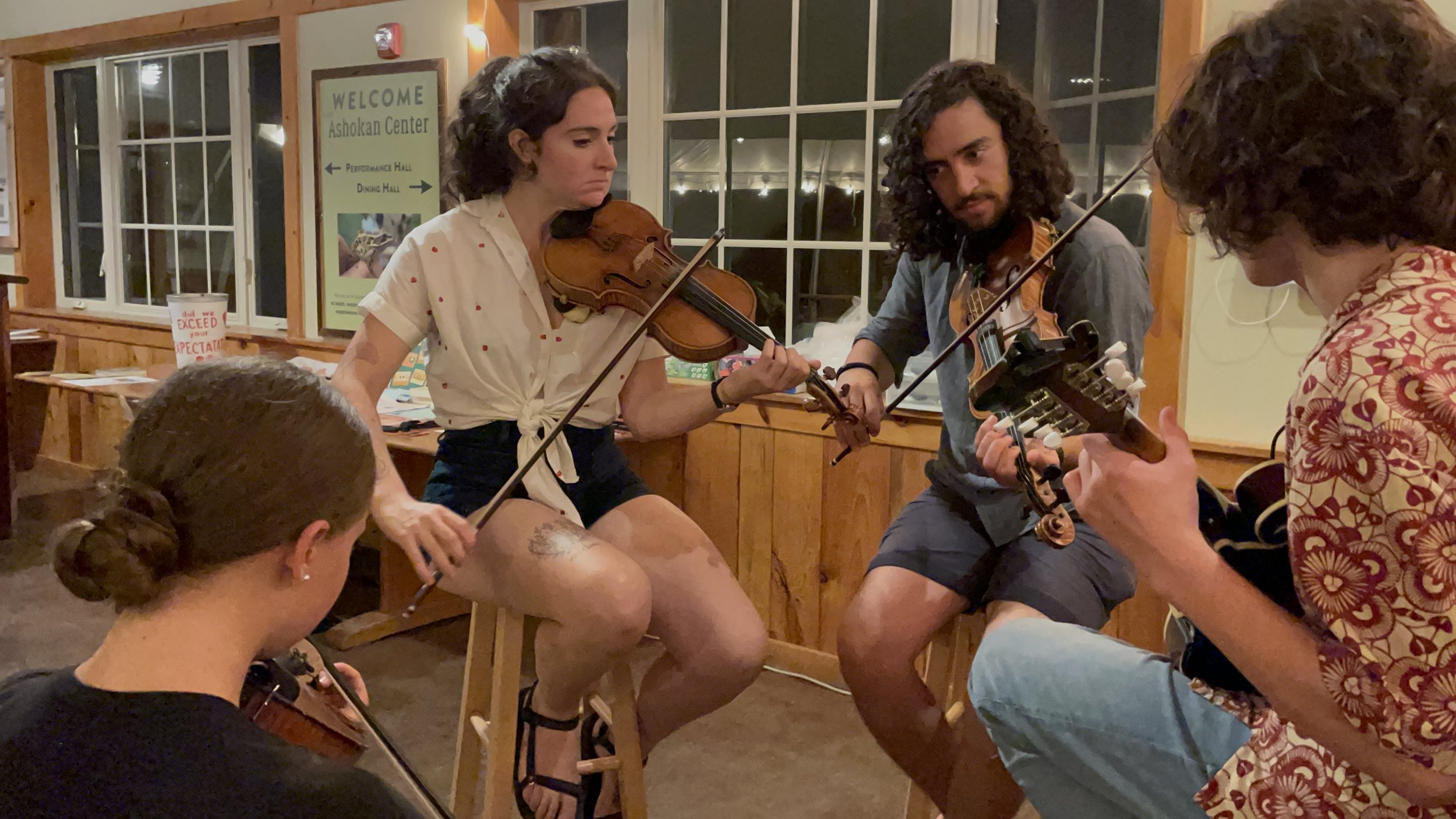
Ashokan Farewell was named for the Ashokan Center, an historic nature and cultural in the Catskill Mountains not far from Woodstock, New York. It’s the place where Jay & Molly have run the Ashokan Music & Dance Camps for adults and families since 1980.
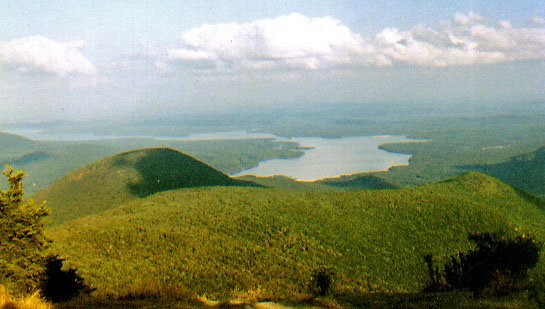
Ashokan is the name of a town, most of which is now under a very beautiful and magical body of water called the Ashokan Reservoir, which provides drinking water for New York City one hundred miles to the south. Locally, it’s pronounced a-shó-kun, a-shó-kan, or sometimes ásh-o-kán.
Press
Jay Ungar & Molly Mason are masters of music and storytelling who generously share their lives and their music with audiences. There are so many moments and strands to savor in the course of an evening of their music.
—
Jay’s fiddling is brimming with playfulness, drama, soulfulness and technical verve, as he explores the many musical styles and idioms that he has internalized and made his own. Molly’s total mastery and inventiveness on piano and guitar is always spot-on, as she supports the tunes and follows the flow of the melody. Her rich and expressive vocals along with the resonant strains of Jay’s violin, reveal the deep emotions that flow in the duos veins.
Millions were entranced by the music they did for Ken Burns’ PBS documentary The Civil War. Their performance of the series’ signature tune, Jay’s haunting composition, Ashokan Farewell, earned the couple international acclaim. The soundtrack won a Grammy and Ashokan Farewell was nominated for an Emmy.
This simple, but powerful melody was originally inspired by the week-long Ashokan Music & Dance Camps that Jay & Molly run for adults and families at The Ashokan Center in the Catskill Mountains. People attend the camps to become better fiddlers, guitarists, mandolin players, percussionists, dancers, dance callers and instructors—and in doing so they become links in the chain that helps pass our folk heritage from the people who came before us, to those who will follow.
GET TO KNOW JAY AND MOLLY
It started with a chance meeting in the late 1970s.
Jay & Molly were each performing at the Towne Crier, a rural New York club. They hit it off musically and played together from time to time until Molly headed off to Minnesota to work in the house band of a new radio show: Garrison Keillor’s A Prairie Home Companion.
Meanwhile, back in New York, Jay put together a band with fellow fiddlers Evan Stover and Matt Glaser and guitarist Russ Barenberg.
When Fiddle Fever, as the collaboration was called, needed a bassist, Molly signed on. The group recorded two classic LPs, now available on CD as The Best of Fiddle Fever (Flying Fish Records).